Virtual Prototyping Labs Reshaping Custom Fits for Cyclists and Tennis Players Through Motion Data Integration
Ulrich Schmidt · Oct 26, 2026
Virtual Prototyping Labs Reshaping Custom Fits for Cyclists and Tennis Players Through Motion Data Integration
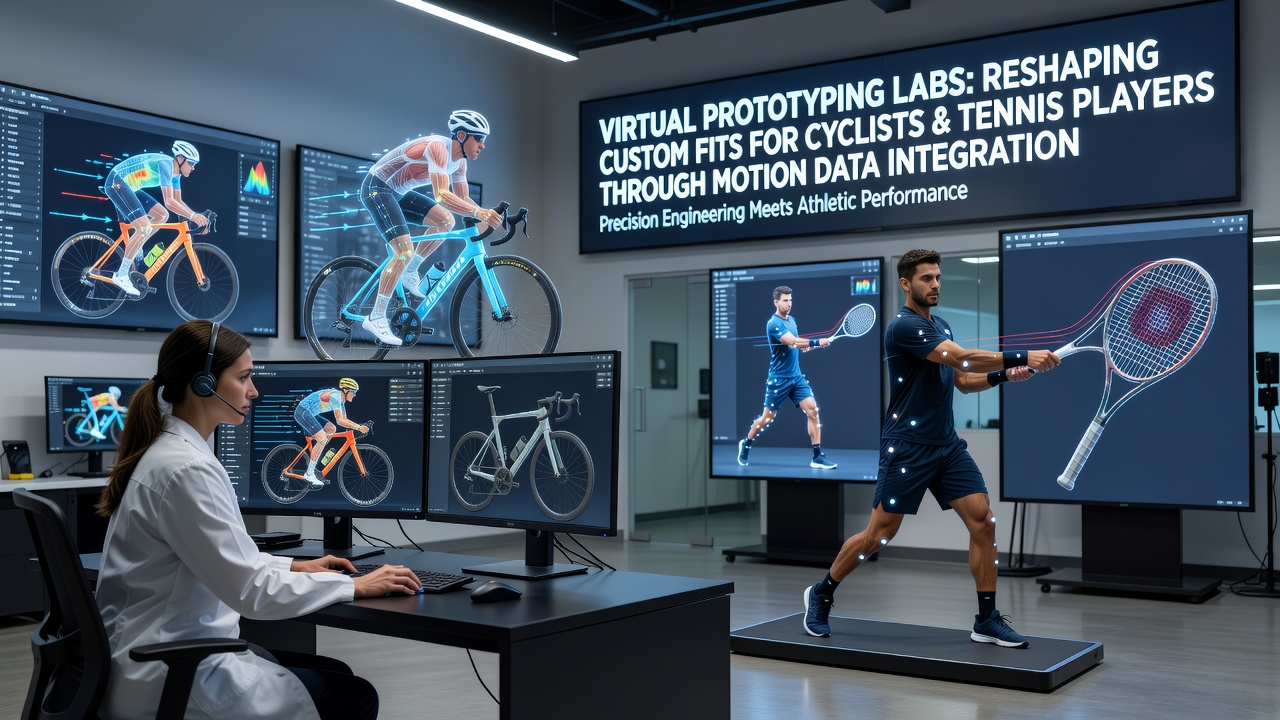
Specialized facilities now combine high-speed motion capture cameras with computational modeling software to create individualized equipment configurations for cyclists and tennis players, and these labs process streams of biomechanical data that translate directly into adjustments for bike frames, saddles, handlebars, rackets, and grip tapes. Researchers collect thousands of data points during controlled movement trials, then feed those readings into simulation environments that predict how small geometric changes affect force distribution, joint angles, and power output over repeated cycles.
Motion Capture Systems Driving Equipment Customization
Technicians attach reflective markers to athletes and their gear before recording sessions that last several minutes, and infrared cameras track marker positions at rates exceeding 200 frames per second while force plates beneath the equipment register ground reaction forces and torque values. Software packages then reconstruct three-dimensional skeletal models, calculate joint centers, and identify movement patterns that deviate from optimal ranges established through prior population studies. Engineers adjust virtual prototypes within the same environment, testing new saddle heights or racket handle circumferences without requiring physical iterations until final validation stages.
Data integration pipelines connect raw kinematic outputs to computer-aided design files, allowing rapid iteration on component dimensions such as stem length for cyclists or beam width for tennis rackets. One laboratory documented reductions in peak knee flexion variability after implementing these loops, with adjustments completed in under two hours compared with traditional fitting methods that required multiple shop visits. Observers note that the same datasets also reveal asymmetries in pedal stroke or serve mechanics, prompting additional recommendations for training interventions alongside equipment changes.
Applications for Cyclists and Performance Metrics
Cycling labs focus on lower-limb kinematics during steady-state efforts on stationary trainers equipped with power meters, and analysts examine hip, knee, and ankle angles across crank revolutions to determine saddle fore-aft position and crank length. Motion data collected in October 2026 from a cohort of competitive riders showed that personalized virtual fits reduced average hip adduction by 3.2 degrees compared with manufacturer stock setups, according to figures released by the Australian Institute of Sport. Handlebar reach modifications derived from shoulder and elbow tracking further decreased upper-body sway during high-cadence intervals, supporting sustained aerodynamic postures without increased perceived effort.
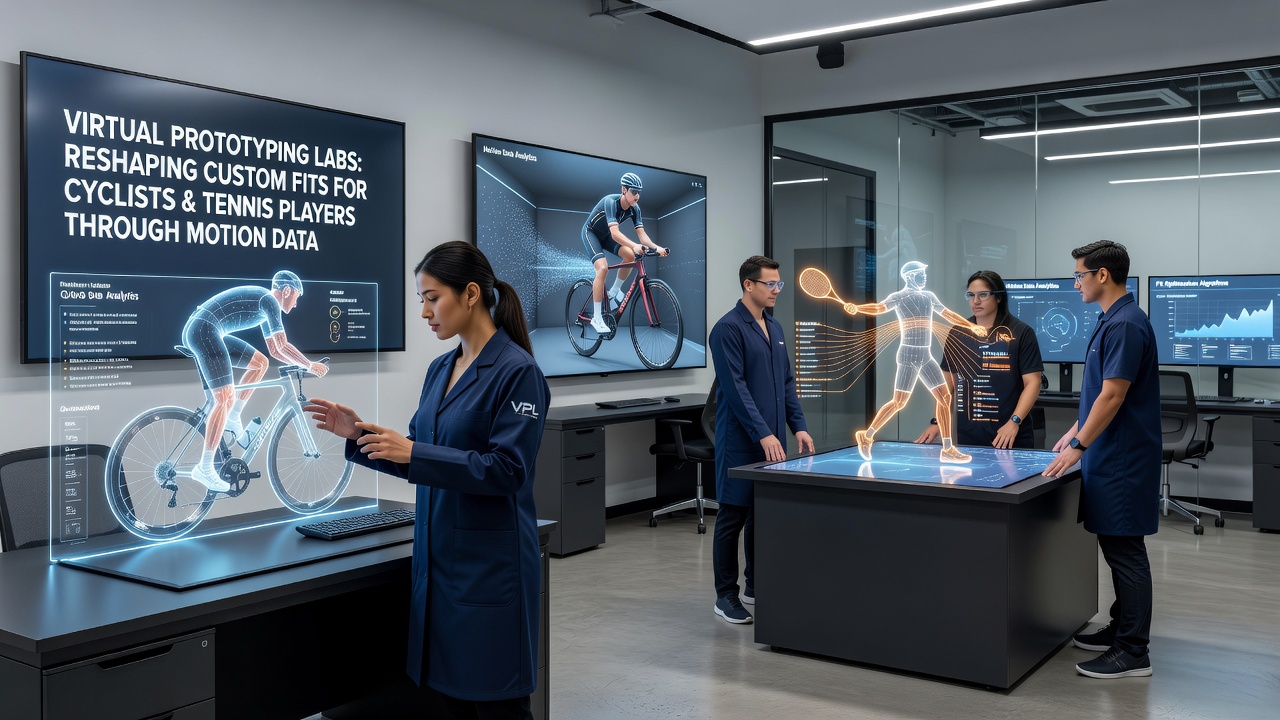
Frame stiffness mapping incorporates rider weight distribution captured through pressure-sensitive mats, enabling material thickness variations along the chainstays and seat tube that match individual pedaling forces. Labs report that these tailored compliance profiles maintain power transfer while attenuating road vibrations in frequency bands most relevant to each athlete's mass and flexibility profile.
Tennis Racket Customization Through Swing Analysis
Tennis-focused facilities record full-body kinematics during groundstrokes and serves, capturing racket head speed, impact location on the string bed, and wrist pronation angles at contact. These measurements inform grip shape modifications that align the handle bevels with natural hand positioning, reducing required compensatory forearm rotation. Researchers at McGill University integrated similar datasets with finite element models of racket frames and found that personalized pallet shapes lowered peak wrist extensor activation by measurable margins during extended rally simulations.
Weighting adjustments inside the racket head or handle follow from calculated moments of inertia derived from swing path data, and manufacturers receive precise counterweight placement coordinates generated by the virtual environment. Grip circumference recommendations incorporate finger length ratios and palm pressure mapping collected during static and dynamic trials, producing handles that maintain consistent contact points throughout the stroke.
Future Developments and Data Standards
Industry groups continue to refine protocols for sharing anonymized motion datasets across facilities, while academic consortia develop open-source algorithms that standardize joint angle calculations and power estimation methods. Integration of wearable inertial sensors with laboratory systems extends data collection into on-court and on-road environments, supplying supplementary inputs that refine virtual models between scheduled lab visits. Regulatory bodies in the European Union have begun evaluating certification pathways for equipment produced through these digital workflows, focusing on reproducibility of fit parameters across different capture setups.
Conclusion
Virtual prototyping laboratories continue to expand their role in performance equipment development by merging detailed motion capture with simulation tools, and the resulting custom configurations for cyclists and tennis players rest on quantifiable biomechanical relationships rather than iterative trial and error. Continued refinement of data pipelines and cross-facility standards supports broader access to these methods while maintaining consistency in outcomes across geographic regions and athlete populations.